How Our AI Photo Location Finder Works: Visual Recognition Without EXIF
Every photo tells a story, but too often, the crucial first chapter—'Where was this taken?'—remains unwritten. Billions of images are shared daily, yet their geographical origins are frequently lost. For years, the answer lay buried in EXIF metadata, a digital fingerprint with GPS coordinates. But what happens when that data is missing? This is where a sophisticated photo location finder tool, powered by AI, becomes indispensable. Our system doesn't just read data—it sees and understands the world within your image. This article pulls back the curtain on the AI that pinpoints a location from a photo with no GPS information. See it in action with our powerful analysis tool.
Understanding Photo Location Finder's Hybrid Geolocation
What if your photo holds a secret location, but the usual clues are missing? Our platform is built for exactly that challenge. We combine the proven power of traditional data extraction with groundbreaking artificial intelligence, ensuring unparalleled accuracy whether your image comes with full metadata or is a complete geographical enigma. We start with EXIF data, but our real strength is what we do when it's not there.
The Limitations of Relying Solely on EXIF Data
EXIF (Exchangeable Image File Format) data, including geotags, has long been the standard for location info. But relying on it alone has major drawbacks:
- Privacy Stripping: Social media and messaging apps often strip this data for privacy.
- Disabled GPS: Users frequently disable GPS tagging on their devices.
- Older Images: Scanned photos or images from older cameras lack GPS capabilities.
- Indoor Shots: GPS signals are often weak or unavailable indoors.
These limitations leave many images as geographical blank slates. A simple exif data viewer would come up empty, but this is where our AI excels.
The Rise of AI Visual Analysis for Image Location Finder
When metadata fails, AI steps in. AI visual analysis trains algorithms to interpret patterns, objects, and scenes within an image, much like a human would. Instead of reading code, the AI seeks visual clues. This isn't sci-fi anymore. Thanks to rapid advancements, this technology has transformed what was once an impossible task into a seamless, practical tool for identifying locations from visual data alone. By leveraging neural networks trained on billions of images, our image location finder can identify subtle hints that would escape the human eye, turning your photo into a set of solvable geographical clues.

How AI Image Recognition Finds Visual Geolocation Clues
So, how does an AI actually "see" a location? It’s a systematic process of breaking down an image into identifiable components and cross-referencing them with a vast global database. The AI acts like a seasoned detective, meticulously searching for clues that, when combined, point to a specific place on the map. This advanced method is what makes it possible to geolocate a photo from its content alone.
Identifying Distinctive Landmarks and Architecture
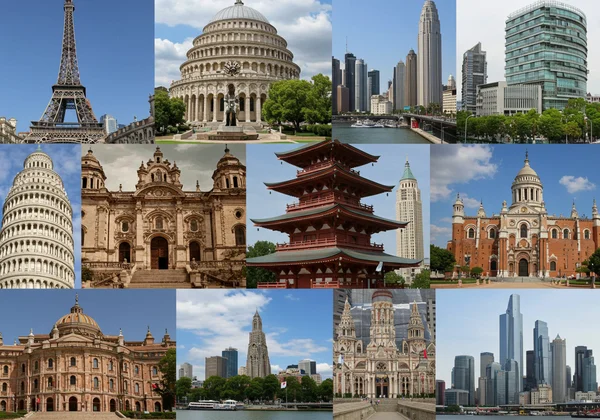
The most obvious clues are distinctive landmarks. An image of the Eiffel Tower or Statue of Liberty is an easy win. But our system goes deeper, recognizing thousands of less-famous landmarks, from specific bridges to unique monuments. It also analyzes architectural styles. A Spanish colonial mission, a Japanese pagoda, or a modern brutalist structure are all geographically concentrated, providing powerful evidence to narrow the search from a continent to a specific city.
Analyzing Natural Elements: Flora, Fauna, and Topography
Landscapes are filled with geographical markers our AI is trained to identify:
- Flora: Specific trees, plants, and flowers indicate a climate and region. A Joshua Tree points to the Mojave Desert, while cherry blossoms suggest East Asia.
- Fauna: Certain animals are a strong clue. A kangaroo places the photo in Australia; a polar bear indicates an Arctic region.
- Topography: The shape of the land is critical. The AI analyzes mountain ranges, coastlines, and rock formations, matching them against topographical maps and satellite imagery. Red rock arches strongly suggest the American Southwest. Our picture location finder excels at this.
Deciphering Cultural Cues and Localized Objects
Subtle cultural details are often the most compelling clues. The AI is trained to scan for:
- Language and Text: Street signs, storefronts, and advertisements are powerful indicators.
- Vehicles: Car models, license plate styles, and public transport (like London's double-decker buses) are often unique to a country.
- Local Objects: Fire hydrants, mailboxes, and even trash cans have distinct regional designs.
Combining these clues, the AI builds a comprehensive geographical profile of the image.
The AI Inference Process: From Pixels to Pinpoints with AI Photo Analysis
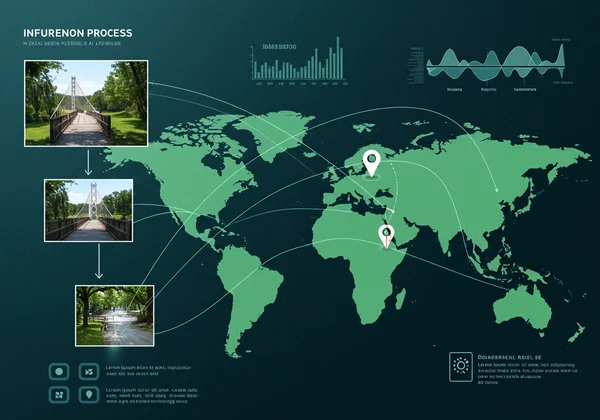
Identifying clues is the first step. The magic happens during inference, where data is synthesized to produce a location. At Photo Location Finder, we show you the AI's "thought process" as it works. This commitment to clarity is a core part of our AI photo analysis.
Cross-Referencing Visuals with Geospatial Data
Once the AI identifies visual clues—a bridge, a tree, a license plate—it begins a massive cross-referencing process against a database of geotagged images and satellite data. For example, if the AI identifies the "Golden Gate Bridge" and "coastal fog," it queries its database for locations with both elements, filtering out millions of incorrect possibilities. More clues allow it to triangulate results, progressively narrowing the search to a precise set of coordinates. You can find location from image with this powerful technique.
Understanding Confidence Scores and Alternative Geotags
We know AI isn't infallible, so we provide a confidence score. This score represents the AI's certainty based on the evidence it found. A photo with a clear, famous landmark gets a high score; a blurry image of a generic forest gets a lower one. Our system also provides alternative geotags if clues could plausibly point to multiple locations. This transparency allows you to make an informed judgment and sets our visual geolocation tool apart.
Unlock the Hidden Stories in Your Photos
Finding a photo's location without EXIF data is more than a technical marvel; it’s a new way to connect with your memories. Whether you're a journalist verifying a source, a traveler mapping a journey, or just curious about an old family photo, AI image recognition provides the key. The technology is complex, but the experience is simple. You don't have to wonder where a picture was taken—now you can find out. We invite you to experience this firsthand. Upload a photo today and watch our AI uncover its origin.
Your Questions About AI Photo Location Analysis Answered
Can AI accurately find a location if a photo has no GPS data?
Yes, absolutely. This is our AI's primary strength. By analyzing visual clues like landmarks, architecture, and vegetation, our system determines a location with high accuracy even without GPS data. The more distinct visual information the photo contains, the better the result.
How does AI recognize specific landmarks in a picture?
Our AI is trained on a massive dataset of geotagged images of landmarks worldwide. It learns to identify their unique shapes, textures, and features. When you upload a photo, the AI compares its visual data against this trained knowledge to find a match, similar to facial recognition but for places.
What types of visual clues does AI use for geolocation?
The AI uses a wide range of clues, from obvious ones like famous buildings to subtle hints like architectural styles, regional plants, text on signs, and license plate designs. It combines these data points to form a complete picture of the potential location. You can test this with our photo location finder.
Is Photo Location Finder's AI process transparent?
Yes, transparency is a core principle. After analyzing an image, our tool displays the AI's step-by-step reasoning. You can see which clues it identified (e.g., "Eiffel Tower detected") and how it reached its conclusion, helping you trust the result and understand the technology.
How reliable is AI visual geolocation compared to EXIF data?
When accurate EXIF GPS data is available, it's the most reliable source. However, AI visual geolocation is a powerful alternative when that data is missing. Its reliability depends on the image clarity and content. For a photo with clear landmarks, the AI's result can be just as precise. We always recommend using our hybrid analysis tool to check for both.